

How Does Stereovision Work?
Each eye sees a slightly different image of the world. The brain combines these two images into a single, three-dimensional view - creating depth perception. This process happens automatically and continuously, allowing us to interact smoothly with our environment.


Why is Stereovision Important?
Stereovision plays a key role in everyday activities, including:
- Catching and throwing objects
- Reading and focusing comfortably
- Judging distances when walking, stepping or driving
- Coordinating hand and eye movements
In children, it is especially important for development, learning, and confidence.
Signs a Child May Have Reduced Stereovision (Depth Perception)
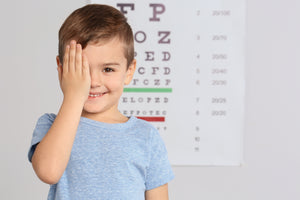
Depth perception problems in children are not always obvious. Many children with reduced stereovision can still see clearly on a standard eye chart, but may struggle with activities that require accurate judgement of distance, movement, and spatial awareness.
Some children adapt well and may not realise their vision is different from others. Early testing can help identify binocular vision problems that might otherwise go unnoticed.
Common Signs of Reduced Stereovision
Children with reduced stereovision or depth perception difficulties may:
- Struggle to catch or throw balls accurately
- Frequently bump into objects, doorways, or furniture
- Find stairs or uneven surfaces difficult
- Avoid sports or activities requiring coordination
- Hold books very close when reading
- Tilt or turn their head when focusing
- Close one eye in bright sunlight
- Have reduced confidence in physical activities
- Seem clumsy compared with other children of a similar age
- Experience visual fatigue during close work
These signs do not always mean a child has a stereovision problem, but they can indicate that further binocular vision assessment may be helpful.
Conditions Commonly Associated with Reduced Stereovision
Reduced stereovision can occur when the eyes are not working together effectively. This may be linked to conditions such as:
Strabismus (Squint)
A misalignment of the eyes where one eye may turn inwards, outwards, upwards, or downwards. This can affect how the brain combines information from both eyes.
Amblyopia (Lazy Eye)
Reduced vision in one eye during childhood development, often associated with weaker binocular vision and reduced stereoacuity.
Binocular Vision Disorders
Some children have difficulty coordinating eye movements even when both eyes appear straight.
Following Eye Treatment
Stereovision testing may also be used during or after treatment for binocular vision conditions to assess improvement in depth perception.
Why Early Stereovision Testing Matters
Good stereovision supports many everyday activities including learning, movement, coordination, and confidence. Identifying reduced stereo vision early may help clinicians monitor binocular vision development and support appropriate treatment where needed.
Stereovision testing is commonly carried out by:
- Orthoptists
- Optometrists
- Ophthalmologists
- Paediatric vision specialists
- Some Doctors such as General Practitioners
The Frisby Stereotests are designed to assess stereopsis using real depth targets viewed naturally without special glasses.


How is Stereovision Measured?
Stereovision is measured using tests called stereotests. These tests assess how well the brain combines input from both eyes and how accurately depth can be perceived. Results are typically measured in seconds of arc, with lower values indicating finer depth perception.
Stereovision is routinely assessed by optometrists (opticians), orthoptists, and ophthalmologists as part of binocular vision testing.
How Do Stereotests Work?
Different types of stereotests exist. Some use special glasses to present separate images to each eye. Unlike many stereotests, the Frisby Stereotest uses real physical depth that can be seen naturally, without the need for glasses. This allows testing in natural viewing conditions, makes it suitable for young children, as well as supporting more reliable results.
Stereovision testing can help identify binocular vision problems that may not always be detected through standard visual acuity testing alone.
Kristina Alexander
Senior Orthoptist, John Radcliffe Orthoptics Department, Oxford, UK
When should Stereovision be Tested?
Stereovision may be assessed:
· During routine eye examinations
· If a child shows signs of coordination or visual difficulty
· When a squint (strabismus) is present
· During or after treatment for amblyopia (low vision in one eye)
Early testing can help identify issues that might otherwise go unnoticed.
FAQs
What is Stereovision?
Stereovision — also known as stereopsis — is the ability to see depth and perceive the world in three dimensions. It happens when the brain combines slightly different images from each eye into a single image with depth information.
Good stereovision helps us judge distances accurately and supports many everyday activities, including movement, coordination, reading, and sports.
What is Stereopsis?
Stereopsis is the visual process that allows the brain to combine information from both eyes to create depth perception. It is an important part of binocular vision and helps us understand how far away objects are in relation to each other.
What Causes Poor Depth Perception?
Reduced depth perception can occur when the eyes do not work together effectively. This may be associated with conditions such as strabismus (squint), where the eyes do not align properly, amblyopia (lazy eye), or other binocular vision problems.
Some children with reduced stereovision may still pass a standard eye chart test used to measure how clearly each eye can see. This is because standard eyesight tests mainly assess visual acuity, rather than depth perception and binocular vision.
How is Stereovision Tested?
Stereovision is assessed using specialised stereotests that measure how accurately the brain combines visual information from both eyes.
Different stereotests use different methods. Some use special glasses, while others — such as the Frisby Stereotests — use real depth targets viewed naturally without glasses.
At What Age Should Stereovision be Tested?
Stereovision is often assessed during childhood eye examinations, particularly if there are concerns about coordination, eye alignment, reading comfort, or visual development.
Early assessment can help identify binocular vision problems that might otherwise go unnoticed.
Can a Child Have Poor Depth Perception with Normal Eyesight?
Yes. A child may be able to read a standard eye chart clearly but still have reduced stereovision or binocular vision difficulties.
Because stereovision depends on how both eyes work together, standard eyesight tests do not always assess depth perception fully.
Who Typically Tests a Child's Stereovision (depth perception)?
Stereotests are commonly used by orthoptists, optometrists, ophthalmologists, and paediatric vision specialists.
In some areas, children may receive vision screening during their early school years or at nursery. If there are concerns about a child’s vision, depth perception, or eye coordination, an appointment with an optometrist (optician) or general practitioner (GP) is often a good first step.
Do All Stereotests Require Glasses?
No. Some stereotests use special glasses to separate two different images presented to each eye. Others, including the Frisby Stereotests, use real depth targets that can be viewed naturally without glasses.
This allows testing in more natural viewing conditions and can be particularly useful for young children.

More About Frisby Stereotests
Explore stereotests designed for assessing stereopsis and depth perception in children and adults.