
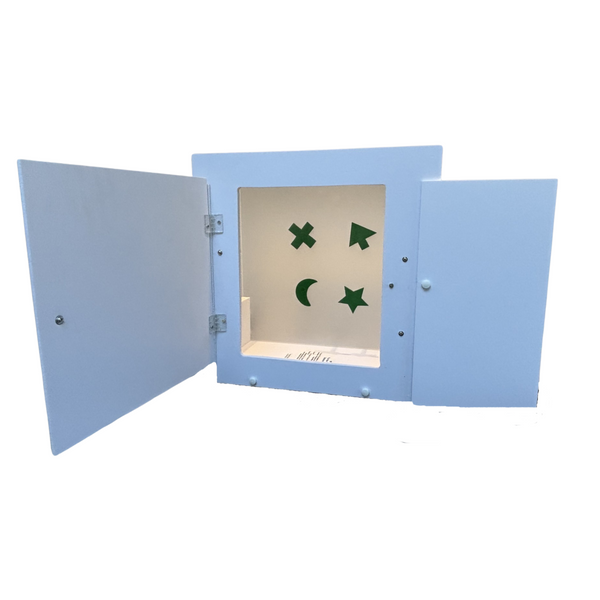


THE FRISBY DAVIS DISTANCE STEREOTEST (FD2) – Distance Stereo Vision Test
Plus VAT (UK only) & Delivery
In stock
Ordering with a PO Number?
Send an order via our Contact page or email us at sales@frisbystereotest.co.uk
EU MDR Compliant
All Frisby Stereotests bear the CE marking and sell in the EU.
Optician Magazine
Read the article on Frisby Stereotest published in Optician magazine here.
The Frisby Davis FD2 is a distance stereo vision test used in clinics and research to screen and measure stereopsis at real viewing distances.
• Clinical distance stereopsis test
• Measures stereo vision at real distances
• Useful for assessing binocular vision disorders
• Used in clinical research and specialist vision clinics
• Provides accurate depth perception measurement
Full Descripton:
First launched in 2003 and now relaunched with improved design adjustments, the new FD2 provides distance stereo acuity measurements using real objects as targets.
It has been developed based on the Frisby Stereotest (Near) test, and because it functions as a free-space test using real depth, it eliminates the need for stereograms and special glasses—ideal for young children from 36 months (who may resist wearing them), as well as adults and the elderly.
It features four distinct flat plastic shapes mounted on rods within a translucent support panel. In each trial, one shape (the target) is positioned closer to the observer by adjusting its supporting rod, while the other three remain flush with the panel. The dark-colored shapes obscure the rods, creating the illusion of floating objects.
Disparity settings range from 50 to 5 arcseconds in 5” steps at a 6m viewing distance, though shorter distances can be used with caution. The observer’s task is to identify the nearest shape, with target selection varying between trials. Side panels and a closing door prevent the observer from seeing adjustments.
Shapes—an arrow, a cross, a star, and a crescent moon—are designed to be easily recognisable for children, ensuring accessibility and engagement during testing.
The test has been developed to minimise monocular clues, and a monocular test phase after binocular testing should be completed to ensure effective testing protocol.
Clinical Applications
• Measurement of distance stereopsis in clinical settings
• Assessment of binocular vision disorders
• Evaluation of stereo vision in patients with strabismus
• Used in specialist orthoptic clinics and vision research
"The FD2 is a great distance stereo test and one that I enjoy teaching our students about."
Karzan Hughes
University teacher in Orthoptics


